
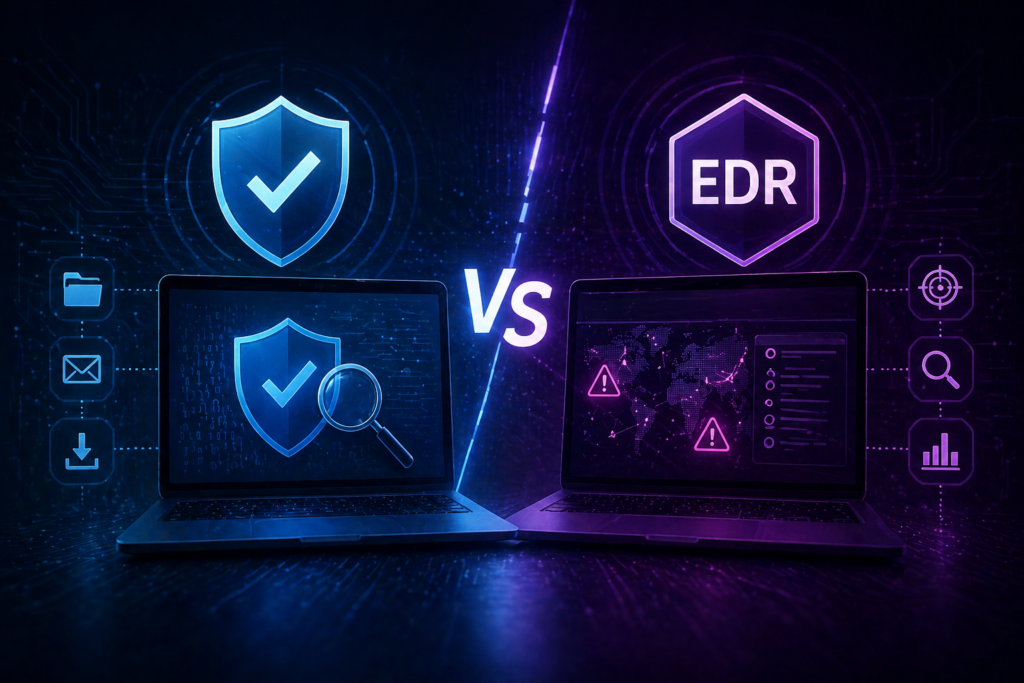
Endpoint security is one of those terms that gets used constantly and explained rarely. If your current IT provider has told you that you’re protected without specifying how, or if “antivirus” is the complete answer you’ve been given, this article is for you. In 2026, the gap between antivirus and modern endpoint detection and response isn’t a technicality — it’s the difference between detecting a threat and stopping one. For a business hit by ransomware, it’s the difference between a two-minute automated recovery and a week of downtime.
What an Endpoint Is
An endpoint is any device that connects to your network: laptops, desktops, servers, smartphones, and tablets. Each is a potential entry point for an attacker. Endpoint security refers to the technologies and practices designed to monitor, protect, and respond to threats at the individual device level — as opposed to network security, which operates at the boundary between your network and the internet.
Both layers matter and work together. A properly configured SonicWall firewall at your perimeter and endpoint security on every device is the correct architecture. Relying on only one layer is the equivalent of locking your front door while leaving every window open. You’ve made entry harder from one direction. You haven’t secured the building.
Traditional Antivirus: How It Works and Where It Falls Short
Traditional antivirus operates primarily through signature matching. The vendor maintains a database of known malicious files and code patterns. When a file is accessed or executed, the antivirus compares it against that database. Known threats are blocked. Unknown threats pass through.
This model has a fundamental structural weakness in the current threat environment: it requires the threat to already be known. New malware variants are created continuously, and threat actors specifically engineer their tools to avoid matching existing signatures. By the time a vendor’s database is updated, the attack has already moved on. Worse, modern attacks increasingly avoid traditional files entirely — they use legitimate Windows system tools, PowerShell scripts, and memory-based techniques that leave nothing on disk to scan.
Antivirus still has value as one layer in a defense stack. The problem is treating it as the primary or sufficient layer in 2026. It isn’t, and organizations that have suffered ransomware events after relying solely on antivirus have experienced that gap directly.
EDR: What Behavioral Detection Actually Means
Endpoint Detection and Response was developed specifically to address the gaps that signature-based antivirus cannot close. EDR monitors the behavior of processes in real time — not what files exist, but what programs are doing: which files they’re accessing, what network connections they’re making, what registry changes they’re attempting, how they’re interacting with other processes.
When a process behaves like malware — beginning to encrypt files rapidly, attempting to disable security tools, communicating with a known malicious server, spawning unexpected child processes — EDR responds immediately. Depending on severity and configuration: alert, isolate, kill the process, or roll back its actions entirely. Critically, behavioral detection works regardless of whether the specific threat has ever been seen before. New ransomware still behaves like ransomware. EDR catches it by what it does.
SentinelOne in Practice at Acme
We deploy SentinelOne as the endpoint security standard across every managed client. In practice, this means continuous behavioral monitoring on every device in your environment, autonomous threat response that doesn’t require a human to be awake to act, and rollback capability that can undo the damage of an attack if one reaches an endpoint.
Questions Worth Asking Your Current IT Provider
- Is our endpoint protection signature-based, behavior-based, or both?
- Does it respond to threats automatically, or does it only alert?
- Does it include rollback capability if ransomware encrypts files?
- Is it centrally managed and actively monitored, or installed and left unattended?
- When were the agents last updated across all of our devices?
If those answers leave you uncertain, it may be worth a conversation. Reach out at Contact Us.
Find out if your endpoints are actually protected: Contact US

